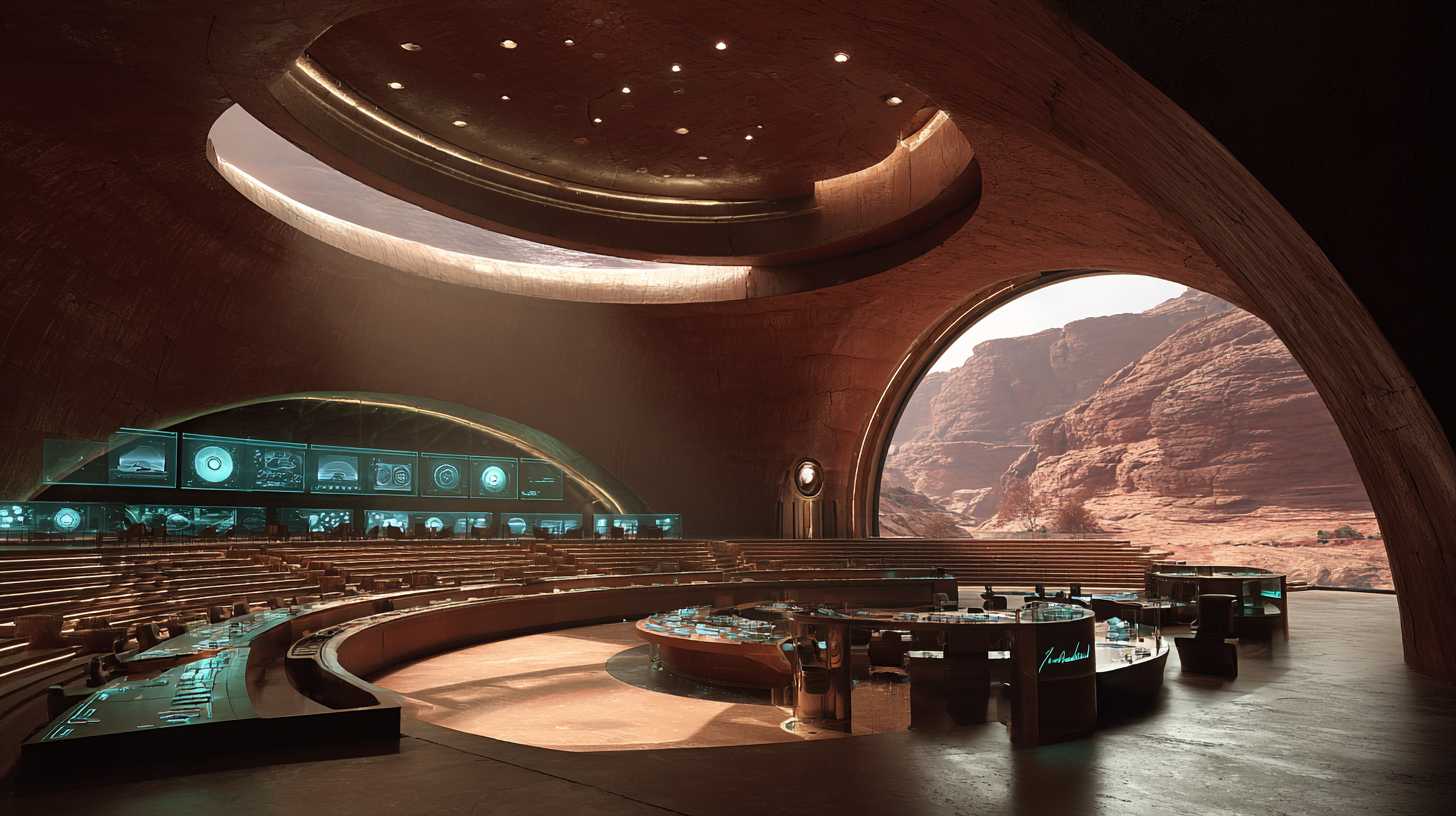
On Earth, governance evolved over millennia through trial, revolution, and compromise. On Mars, we have the rare opportunity to design governance from first principles — informed by everything humanity has learned, unconstrained by everything humanity got wrong.
The Martian Republic is a direct democracy built on the Marscoin blockchain. Every citizen gets one vote. Every vote is cryptographically secret. Every result is publicly auditable. There are no representatives, no lobbyists, no electoral college. Just citizens, proposals, and the transparent mathematics of consensus.
This article explains how it all works — the four-tier proposal system, the voting mechanics, the privacy-preserving ballot protocol, and the hard-won lessons from a decade of blockchain governance experiments that shaped these choices.
Why Not Just Use What Earth Has?
Earth's democratic systems were designed for a world of millions, with pre-digital communication, geographically distributed populations, and centuries of institutional inertia. They work — imperfectly — for Earth. They would fail catastrophically on Mars.
A Mars colony starts small. Perhaps 30 people. Then 300. Then 3,000. The governance system must work at every scale, growing with the colony without requiring constitutional crises to evolve. Representative democracy doesn't make sense at 30 people. Pure direct democracy becomes unwieldy at 30,000. The system must handle both.
Meanwhile, the blockchain governance experiments of 2016–2026 produced their own lessons, often learned at enormous cost. Over 13,000 DAOs (Decentralized Autonomous Organizations) now manage more than $21 billion in treasury assets. The median voter participation across the ecosystem sits below 5%. The top 10% of token holders control 76% of voting power. Flash loan attacks have stolen hundreds of millions. Voter fatigue has killed multiple organizations.
The fundamental problem: Researchers have mathematically proven that tokens as the sole instrument for weighting votes cannot simultaneously resist both Sybil attacks (fake identities) and plutocracy (rule by the wealthy). Any system seeking fairness needs either a robust identity layer or a second instrument like time commitment.
— Mohan, Khezr, and Berg (2024), Management Science
The Martian Republic solves this at the root. Citizenship is earned through social endorsement by existing citizens — not purchased with tokens. One citizen, one vote. The Sybil problem is solved by the community itself, through the same social processes that every human society has used to establish trust since the beginning of civilization.
The Four Tiers of Martian Governance
Not every decision carries the same weight. Choosing where to plant a greenhouse is not the same as rewriting the constitutional code. The Martian Republic uses a four-tier proposal system where the requirements scale with the consequences of the decision.
| Tier | Quorum | Approval | Duration | Timelock | Expires |
|---|---|---|---|---|---|
| Signal | 10% active | 50%+1 | 7 sols | — | Non-binding |
| Operational | 25% active | 60% | 14 sols | 3 sols | 668 sols |
| Legislative | 40% active | 66% | 30 sols | 7 sols | 2,672 sols |
| Constitutional | 50% active | 75% | 60 sols | 30 sols | Never |
The quorum is measured against active citizens — those who have voted or endorsed within the trailing 180 sols — not the total citizenship. This is a critical design choice, learned from the failures of Compound, Yam Finance, and dozens of other DAOs that set quorum against total membership and watched governance grind to a halt as inactive accounts inflated the denominator.
Tier 1: Signal
Signal
Signal proposals are non-binding. They don't execute code or allocate funds. They measure where the community stands on an issue before anyone invests the effort of drafting formal legislation. Because they're low-stakes, Signal proposals skip the CoinShuffle ballot protocol — citizens vote with simple signed messages from their civic addresses, trading ballot secrecy for convenience.
Nearly every successful governance system uses temperature checks as a filter. Uniswap's 4-stage pipeline, MakerDAO's forum signals, Arbitrum's Snapshot polls — they all learned that letting the community self-filter before formal votes dramatically reduces voter fatigue and improves proposal quality.
Tier 2: Operational
Operational
Operational proposals are binding and use CoinShuffle for ballot privacy. They carry a 3-sol timelock — a mandatory delay between vote passage and execution. This opt-out window gives citizens time to realize something problematic passed while they were busy with other duties. Beanstalk's $182 million exploit happened partly because there was no delay between vote completion and fund transfer.
Operational decisions expire after one Martian year (668 sols). If the community still wants the policy, they must actively renew it. This built-in sunset prevents the regulatory accumulation that plagues Earth's legal systems.
Tier 3: Legislative
Legislative
Legislative proposals require a two-thirds supermajority and carry a 7-sol timelock. They also introduce the Quiet Ending mechanism: if the vote outcome flips during the final 3 sols of the voting period, the deadline automatically extends by 7 sols. This prevents last-minute vote manipulation — a tactic that plagued early DAO governance.
Legislative decisions expire after approximately 4 Earth years (2,672 sols), ensuring that significant policies are periodically re-evaluated by the current community rather than inherited indefinitely from past citizens.
Tier 4: Constitutional
Constitutional
Constitutional proposals are the highest tier. They change the Republic itself — its code, its rules, its governance parameters. The proposal text for a Constitutional change is literally a code diff: the exact modifications to the Republic's source code, reviewable by every citizen.
The 30-sol timelock gives citizens a full Martian month to review code changes, test them in staging environments, and organize opposition if needed. Constitutional changes never expire — they persist until amended through the same process. This is git-as-constitution: the codebase is the law, pull requests are proposals, and merge approvals are votes.
Self-amending governance. Tezos, the only blockchain to achieve 18 consecutive protocol upgrades through on-chain governance without a contentious fork, proved this model works. The Martian Republic extends it further: the entire application, not just the blockchain protocol, is subject to citizen governance.
Secret Ballots: CoinShuffle
On Earth, ballot secrecy is enforced by physical voting booths and sealed envelopes. On a public blockchain, every transaction is visible to everyone. How do you vote secretly on a transparent ledger?
The Martian Republic uses CoinShuffle — a cryptographic mixing protocol that severs the link between a citizen's identity and their ballot. Here's how it works, simplified:
- When a citizen requests a ballot, they generate a fresh, anonymous Marscoin address that cannot be linked to their civic identity.
- Multiple citizens participate in a cryptographic shuffle. Each citizen encrypts their anonymous address in layers, like a digital Russian nesting doll. The shuffle ensures that no single participant — and no observer — can match citizens to ballot addresses.
- After the shuffle, each citizen's anonymous address receives a small amount of MARS from the protocol, funding their ballot.
- The citizen casts their vote (YES, NO, or ABSTAIN) from their anonymous ballot address. The vote is recorded on-chain, permanently and immutably, but the voter's identity remains unknown.
The result: every vote is auditable (anyone can verify that all votes came from legitimate ballot addresses) but anonymous (nobody can determine how any specific citizen voted). This eliminates vote-buying and coercion — the $46 million bribery market that exists around Curve DAO governance simply could not function if votes were secret.
Who Decides Which Tier?
The proposer selects the tier when drafting their proposal. But any citizen can challenge the classification during a mandatory screening period before voting begins. If challenged, a simple majority of responding citizens can reclassify the proposal (bumping it up, never down). If nobody challenges, the original classification stands.
This is lightweight and self-correcting. Attempting to game the tier system by submitting a Constitutional change as an Operational proposal becomes a reputational cost — everyone can see you tried, and the community corrects it before any damage is done.
Dynamic Quorum: Growing With the Colony
Fixed quorum requirements — "80% of all citizens must vote" — become mathematical barriers as communities grow. The Martian Republic uses an exponential moving average to dynamically adjust what counts as "active":
ActiveN = 0.8 × ActiveN-1 + 0.2 × Actual_Participationlast vote
If participation trends downward, the effective quorum adjusts downward gradually, preventing gridlock. If a contentious proposal drives high turnout, the quorum ratchets up. The system breathes with the community.
This formula, adapted from Tezos's proven governance system, has supported 18 consecutive protocol upgrades without a single contentious fork. It ensures that governance remains functional whether the Republic has 30 citizens or 30,000.
What Earth's Experiments Taught Us
The design of the Martian Republic's governance system didn't emerge from theory alone. It was forged in the wreckage of real-world failures and refined by the rare successes.
- Compound's near-capture (2024): A voting bloc called "Golden Boys" borrowed 228,000 COMP tokens, controlled 81% of the quorum, and passed a proposal transferring $24 million to their own multisig. It was only reversed through social pressure. Lesson: identity-based voting eliminates financial capture.
- Beanstalk's $182M exploit (2022): An attacker used flash loans to acquire governance tokens, voted, and drained the protocol in a single transaction. Lesson: timelocks between voting and execution are non-negotiable.
- The Steem/Hive war (2020): A corporate acquirer colluded with exchanges to use customer tokens for hostile governance takeover. The community forked to create Hive. Lesson: the fork is the ultimate governance safety valve.
- Optimism's Citizens' House: Using identity-based (soulbound) voting, participation ranged from 76% to 97% — dramatically above typical DAOs. Lesson: identity-based governance produces higher engagement than token-weighted systems.
The Republic's open-source codebase preserves the fork as a constitutional backstop. If governance is ever captured, citizens can fork the code — the Constitution itself — and continue the Republic under the legitimate community. This right is not a bug; it is the ultimate check on power.
The Civic Alarm: Engagement by Design
The best governance system in the world fails if citizens don't participate. The Martian Republic addresses voter fatigue through tiered engagement design:
- Signal proposals: Subtle notification. Check them when you feel like it.
- Operational proposals: Standard push notification. "New proposal: Allocate 200 MARS to greenhouse expansion."
- Legislative proposals: Elevated notification with distinct visual treatment. Gets your attention without interrupting your EVA.
- Constitutional proposals: The full civic alarm. "CITIZEN — ATTENTION REQUIRED." Persistent banner, countdown timer, different color scheme. You cannot accidentally ignore it.
Citizens can also tag their interests — resource allocation, infrastructure, science missions, civil rights — and the system surfaces relevant proposals based on those tags. But Constitutional and Legislative proposals always notify everyone regardless of interest tags, ensuring that high-stakes decisions demand broad community attention.
This escalating urgency teaches the governance model through experience. New citizens learn instinctively that a Constitutional vote is a bigger deal than an Operational one, not because they read the documentation, but because the system feels different when one is active.
What the Republic Gets Right
After analyzing 15+ major governance systems, dozens of real-world attacks, and the latest academic research, several features of the Martian Republic represent genuinely state-of-the-art approaches:
- Identity-based voting eliminates the plutocratic capture that has been mathematically proven inherent in token-weighted systems.
- Secret ballots via CoinShuffle prevent the bribery and coercion attacks that plague transparent on-chain voting.
- Git-as-constitution provides unambiguous, machine-verifiable governance rules with no interpretive disputes.
- Built-in sunset provisions address regulatory accumulation, a problem traditional legal systems have struggled with for centuries.
- Dynamic quorum adjustment prevents governance gridlock as the community scales.
- Four clear tiers with functional names (not Earth-law jargon) that any citizen can understand immediately.
The Martian Republic isn't just another DAO. It's an attempt to build governance for a civilization that doesn't exist yet — informed by everything humanity has learned, designed for the realities of another world.
The governance system described here is not set in stone. It is, by design, self-amending. If the community discovers that 40% quorum for Legislative proposals is too high or too low, they can change it — through the very governance process it describes. The code is the constitution, and the constitution evolves with its citizens.
That's how Mars governs itself.