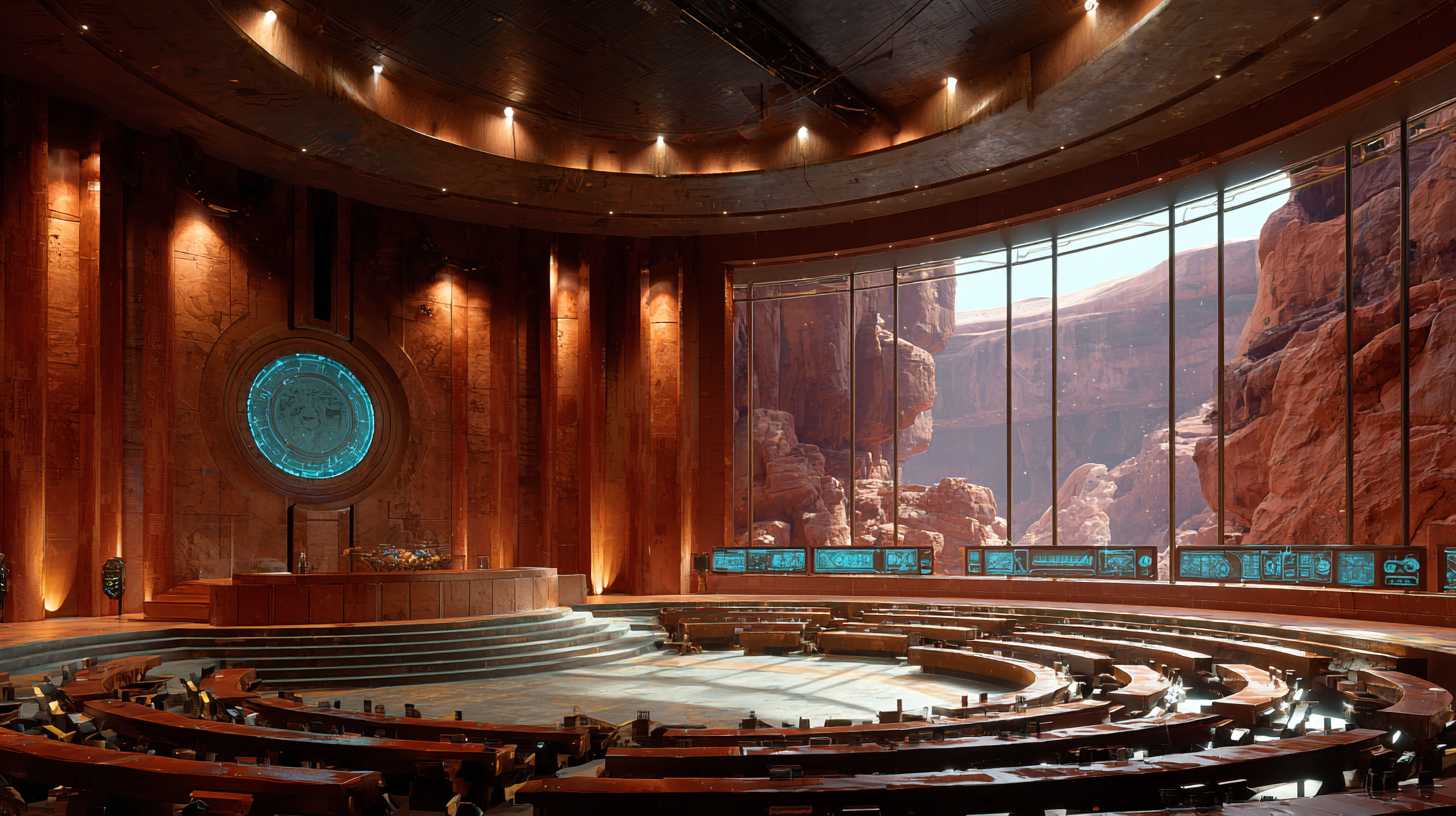
A Martian Republic built on the Marscoin blockchain has a once-in-civilization opportunity to encode the lessons of political history from the start, designing governance as software that evolves with its population from dozens to thousands. This report traces the intellectual and empirical foundations upon which such a constitution should rest, drawing on every major political philosopher, governance experiment, and coordination mechanism that bears on the problem of building a free society from scratch in the most hostile environment humanity has ever attempted to inhabit.
The stakes are unprecedented. Mars colonists cannot leave. They share manufactured air. Communication with Earth takes 3–24 minutes one-way, with 13-day blackout periods every 26 months during solar conjunction. There are no courts, no police, no legacy institutions—only what the colonists build. The Outer Space Treaty of 1967 prohibits national sovereignty claims on celestial bodies, meaning any Martian government must bootstrap its own legitimacy. The Marscoin project and its MartianRepublic.org platform represent the most serious attempt to date to engineer this governance architecture. What follows is the deepest possible historical and theoretical foundation for that effort.
I. The Long Arc of Representation
The concept of political representation is younger than democracy itself. Athenian democracy under Cleisthenes' reforms (508 BCE) was direct: roughly 30,000 adult male citizens could attend the ekklesia in person, though typical attendance hovered around 5,000–6,000. Officials were selected by sortition—random lottery using the kleroterion device—because Athenians considered elections aristocratic. The Boule of 500, selected by lot from ten tribes, set the Assembly's agenda. Pay for attendance, introduced around 395 BCE, widened participation beyond the wealthy. Athens did not represent its citizens; it assembled them.
Athens by the numbers: 30,000 eligible citizens. 40 assembly meetings per year. 6,000 quorum for major decisions. Officials chosen by lottery. Pay for participation. No representatives — just citizens.
Rome pioneered proto-representative structures after deposing King Tarquin in 509 BCE. The Senate, Comitia Centuriata, and Concilium Plebis created layers of mediated authority where votes were counted by units rather than individuals—systematically advantaging the wealthy. The Twelve Tables (c. 450 BCE) established written law; the secret ballot arrived in 139 BCE. The American founders drew so heavily from Rome that they named their upper chamber the Senate and their legislative complex the Capitol.
Medieval England formalized representation as an institution. The Magna Carta (1215) seeded the principle that taxation requires consent. Simon de Montfort's Parliament of January 20, 1265 first included knights from every county and burgesses from major towns alongside barons and churchmen—the embryo of the House of Commons. Edward I's "Model Parliament" (1295) made this permanent. France's Estates-General, first convened April 10, 1302, remained advisory and met so infrequently that when it finally reconvened on May 5, 1789 after a 175-year gap, the Third Estate's demand for voting by head rather than by order triggered the National Assembly, the Tennis Court Oath, and ultimately the Revolution.
The Enlightenment Architects
The Enlightenment produced the philosophical architecture that still frames every governance debate.
Your representative owes you, not his industry only, but his judgment; and he betrays, instead of serving you, if he sacrifices it to your opinion.
— Edmund Burke, speech to the Electors of Bristol, November 3, 1774
John Locke (Two Treatises of Government, 1689) grounded legislative authority in consent and framed it as a fiduciary trust—representatives hold power for the people, and if they violate that trust, the people retain a right of revolution. Montesquieu (Spirit of the Laws, 1748) articulated the separation of legislative, executive, and judicial powers, believing citizens "not fit to discuss affairs" directly but "very well qualified to choose" representatives.
Rousseau's radical dissent: "The moment a people allows itself to be represented, it is no longer free: it no longer exists." He argued sovereignty is inalienable—the general will cannot be delegated. This tension between Locke/Montesquieu's representative optimism and Rousseau's participatory insistence frames the central design question for Mars.
— Jean-Jacques Rousseau, The Social Contract, 1762
Burke's trustee model contrasted with the delegate model associated with Thomas Paine and the Anti-Federalists, which holds that representatives must faithfully transmit constituents' expressed preferences. Hanna Pitkin's The Concept of Representation (1967) argued the tension between these models is a feature, not a bug—both describe real aspects of legitimate representation. Jane Mansbridge (2003) later identified four distinct forms: promissory, anticipatory, gyroscopic, and surrogate.
Madison and the Management of Faction
Ambition must be made to counteract ambition. The interest of the man must be connected with the constitutional rights of the place.
— James Madison, Federalist No. 51, February 8, 1788
James Madison's Federalist No. 10 (November 22, 1787) made the case for representation as faction management: a large republic multiplies factions, preventing any one from becoming tyrannical, while elected representatives "refine and enlarge the public views." Federalist No. 51 supplied the institutional logic: power divided both vertically (federalism) and horizontally (separation of powers) creates what Madison called a "double security."
Representation solves real problems—scale, specialization, deliberation quality, and faction control. But it creates a devastating principal-agent problem identified by Robert Michels in his Political Parties (1911): "Who says organization, says oligarchy." Representatives possess information asymmetry, face weak enforcement (elections are blunt and delayed), and can be captured by donors. As Robert Higgs observed, political contracts lack binding performance terms—how can a congressperson represent hundreds of thousands when a corporate board cannot reliably control a single CEO? The "iron law of oligarchy" suggests that all organizations, including democracies, tend toward elite domination. George Stigler's theory of regulatory capture (1971) showed this extends to bureaucracies designed to serve the public interest. For a Mars colony, these pathologies are not abstract—they are existential risks in a community sharing manufactured air.
II. Direct Democracy: 2,500 Years of Evidence
Athens's direct democracy operated at remarkable scale. By the 4th century BCE, the ekklesia met 40 times per year. A quorum of 6,000 was required for major decisions. Voting was primarily by show of hands, with officials judging outcomes by sight. The graphe paranomon—introduced c. 415 BCE—allowed any citizen to indict the proposer of an unconstitutional decree, functioning as a form of judicial review centuries before Marbury v. Madison. If convicted, the proposer faced ruinous fines; three convictions meant total loss of political rights (atimia). Mogens Herman Hansen estimates this mechanism was invoked roughly once per month, producing approximately 800 cases between 403 and 322 BCE. It was a remarkably sophisticated safeguard, directly relevant to the Martian Republic's tiered proposal system.
Switzerland: The Gold Standard. Since 1848, Swiss citizens have participated in over 600 national referenda and initiatives, voting 3–4 times per year on roughly 15 federal issues. Three instruments exist: mandatory referenda on constitutional amendments (requiring a double majority of popular vote and cantonal majority), optional referenda (triggered by 50,000 signatures within 100 days), and popular initiatives (100,000 signatures within 18 months).
Average turnout hovers around 40–50%, but roughly 90% of citizens participate at least once within any four-year period—suggesting selective engagement rather than apathy. Only ~11% of popular initiatives have been accepted, but their mere existence disciplines the legislature: the threat of a referendum forces broad compromise before bills pass. Freedom House score: 96/100.
Ireland's Citizens' Assemblies. The 2016–2018 Citizens' Assembly—99 randomly selected citizens with no politicians—deliberated for 19 months and recommended repealing the constitutional ban on abortion. The subsequent 2018 referendum passed with 66.4% support. A study comparing the Assembly's deliberative quality with parliamentary committee debate found citizens demonstrated deeper cognitive grasp of the subject matter. Ireland has now held six consecutive sortition-based assemblies producing roughly 100 recommendations and three successful constitutional referenda—the world's leading empirical validation of epistemic democracy.
Blockchain Governance: The Painful Lessons
Blockchain governance experiments provide the most relevant data for the Marscoin project. The DAO (2016) raised $150 million from 11,000+ investors before a reentrancy exploit drained ~$60 million, catalyzing the Ethereum hard fork and the entire blockchain security industry. MakerDAO's token-weighted governance consistently shows less than 5% turnout by MKR supply—a pattern replicated across DAOs.
Snapshot, the dominant off-chain governance platform (~96% market share, 21,000+ spaces, 10 million+ votes), solved the gas-cost barrier and boosted participation by 300%+ in some DAOs, but average turnout remains below 20%. Research by Fritsch, Müller, and Wattenhofer (2022) confirms that DAO governance is "controlled by several dominant voters"—token-weighted voting creates plutocracy by default.
Bryan Ford's liquid democracy proposal (2002) offered an elegant hybrid: voters can participate directly or delegate their vote transitively to trusted proxies, topic by topic, revoking delegation at any time. The German Pirate Party tested this using LiquidFeedback with ~6,000 members. The result was sobering: a single professor became the "liquid democracy superstar," accumulating a disproportionate share of delegated votes. Power concentrated rather than distributed. Ford himself now warns these prototypes should only be used in "friendly security environments." A Stanford study analyzing 250,000+ voters across 1,700+ proposals in 18 major Ethereum DAOs found delegate programs cause modest but real concentration of power.
Four Persistent Challenges
The empirical literature identifies four persistent challenges for direct democracy:
- Rational ignorance (Anthony Downs, 1957): since any individual vote has negligible impact, voters invest little in acquiring information.
- Voter fatigue: California's ballot proposition system regularly presents 10+ measures per election, with research showing voter drop-off on lower-ballot items.
- Tyranny of the majority: between 1998 and 2012, voters in 30 U.S. states approved same-sex marriage bans.
- Manipulation: the 2020 California Proposition 22 saw Uber, Lyft, and DoorDash spend over $200 million to pass a measure the legislature had rejected.
These challenges are not arguments against direct democracy—they are specifications for its design safeguards.
III. What Is a State, and Can One Exist on Mars?
The answer to this question has occupied philosophy's greatest minds for 2,500 years, and Mars forces a return to first principles because every assumption about statehood—territory, sovereignty, monopoly on force, pre-existing social fabric—is absent or transformed.
Plato's Republic (c. 375 BCE) proposed governance by philosopher-kings who had ascended to knowledge of the Form of the Good. His Cave allegory remains the most powerful political metaphor in Western thought: most citizens mistake shadows for reality. Plato ranked democracy second-worst among regimes, above only tyranny. Aristotle grounded political philosophy in empirical observation, analyzing 158 constitutions and concluding that "man is by nature a political animal" (zoon politikon). His sixfold typology—distinguishing governments by whether one, few, or many rule, and whether they serve the common good or private interest—has structured political analysis for 2,300 years. His preferred practical regime, polity, mixed oligarchic and democratic elements through rule by the middle class.
The Social Contract
Hobbes (Leviathan, 1651), writing during the English Civil War, depicted the state of nature as "war of all against all" where life is "solitary, poor, nasty, brutish, and short," justifying an absolute sovereign in exchange for security.
Locke (Second Treatise, 1689) countered with a state of nature governed by reason and natural law, where government exists to protect life, liberty, and property through consent, with revolution as the remedy for tyranny.
Rousseau (Social Contract, 1762) relocated sovereignty permanently in the collective body of citizens, arguing legitimate law must express the general will.
Three visions of political authority. Mars, where colonists share manufactured air and cannot leave, makes the social contract literal rather than metaphorical.
A state is a human community that (successfully) claims the monopoly of the legitimate use of physical force within a given territory.
— Max Weber, "Politics as a Vocation," Munich, 1919
Max Weber provided the definition that anchors modern political science. He identified three types of legitimate authority—traditional, charismatic, and rational-legal—mapping remarkably onto the likely phases of Martian governance: charismatic authority in the founding phase, traditional authority as customs develop, rational-legal authority as institutions mature.
Rawls, Nozick, and Ostrom
Rawls (A Theory of Justice, 1971) proposed choosing principles from behind a "veil of ignorance" where nobody knows their future position—producing two principles: equal basic liberties (lexically prior) and the difference principle (inequalities permissible only if they benefit the least advantaged). The veil of ignorance is an extraordinarily powerful thought experiment for Martian constitutional design: colonists writing rules before knowing their eventual roles would rationally protect the vulnerable.
The Veil of Ignorance on Mars: Imagine writing the rules for a colony before knowing whether you'll be the chief engineer or the newest arrival, the doctor or the janitor. Rawls predicted you would write rules that protect the most vulnerable—because you might be them. On Mars, where manufactured air is shared and exit is impossible, this thought experiment becomes constitutional methodology.
Nozick (Anarchy, State, and Utopia, 1974) argued only a minimal night-watchman state can be morally justified, but his Part III vision of a "framework for utopia"—a meta-framework of voluntary communities under a minimal shared governance—maps directly onto a multi-habitat Mars colony.
Elinor Ostrom (Nobel Prize 2009) demonstrated through 800+ case studies that communities can self-govern common resources without either state control or privatization, identifying eight design principles for successful commons governance that read like a blueprint for Martian habitat management:
- Clearly defined boundaries (who belongs, what's the resource)
- Congruence between rules and local conditions
- Collective-choice arrangements (affected parties write the rules)
- Monitoring by accountable members
- Graduated sanctions (warnings → fines → exclusion)
- Low-cost conflict resolution
- External recognition of self-governance rights
- Nested enterprises for larger systems
On Mars, the atmosphere itself is a manufactured commons. Biosphere 2 demonstrated that living systems in closed habitats are tightly coupled: atmosphere, water, soils, food production, and crew psychology drift together. There can be no "externalities" in the economic sense—every consequence is internalized within the sealed habitat. Ostrom's principles are not just applicable; they are existentially necessary.
The Sovereignty Problem
Sovereignty on Mars presents a genuinely unprecedented challenge. Jean Bodin defined sovereignty in 1576 as "the absolute and perpetual power of a commonwealth." The Westphalian system (1648) established territorial sovereignty and non-interference. But Article II of the Outer Space Treaty (1967)—binding on 118 states—explicitly prohibits "national appropriation by claim of sovereignty, by means of use or occupation, or by any other means." The Moon Agreement (1979) declared lunar resources "the common heritage of mankind," but only 17 states ratified it; no major spacefaring nation signed.
SpaceX's Starlink terms of service assert that Mars is "a free planet" where "no Earth-based government has authority"—legally invalid under current international law but practically provocative, given that communication delays of up to 48 minutes round-trip make Earth-based enforcement effectively impossible. The Harvard International Law Journal (2025) analyzed how a Mars colony might achieve independence through the jus cogens right of self-determination. The practical path is likely analogous to the American founding: de facto autonomy hardening into de jure independence as the colony becomes self-sufficient.
The Martian Republic's "code-as-constitution" approach—where the governance codebase is hashed into the Marscoin blockchain, and code changes constitute constitutional amendments—creates a novel form of sovereignty rooted not in territorial monopoly on violence but in cryptographic consensus and community participation.
IV. Aristotle's Classification Still Maps the Terrain of Failure
Aristotle's sixfold typology works because it captures a deep truth: every legitimate form of government has a corresponding corruption that emerges when rulers pursue private interest over the common good. Polybius (c. 200–118 BCE) extended this into anacyclosis—a cyclical theory where monarchy degenerates into tyranny, which is overthrown by aristocracy, which degenerates into oligarchy, which is overthrown by democracy, which degenerates into ochlocracy (mob rule), which invites a strongman to restore order as monarch.
| Legitimate Form | Rules For | Corrupt Form | Rules For | Decay Mechanism |
|---|---|---|---|---|
| Monarchy | Common good | Tyranny | Private interest | Pride replaces justice |
| Aristocracy | Common good | Oligarchy | Private interest | Virtue decays to indulgence |
| Democracy | Common good | Ochlocracy | Private interest | Freedom degrades to license |
The critical mechanism is generational decay: "The justice of the monarch decays to the pride of the tyrant. The virtue of the aristocrat decays to the indulgence of the oligarch." Polybius argued Rome escaped the cycle through its mixed constitution—consuls (monarchical element), Senate (aristocratic), and popular assemblies (democratic)—each checking the others.
John Adams was the most explicitly Polybian American founder, citing Polybius extensively in his Defence of the Constitutions (1787), which circulated at the Constitutional Convention. Madison prepared "Notes on Ancient and Modern Confederacies" drawing directly from Polybius. The Massachusetts Constitution of 1780, drafted by Adams and still in effect, incorporated Polybian separation of powers.
The Venetian Republic: 1,100 Years of Survival. Venice survived approximately 1,100 years (697–1797)—one of the longest-lived republics in history—through institutional architecture that prevented power concentration. From 1268, the Doge was selected through an extraordinarily complex 10-round process alternating sortition and election, requiring 64–78% supermajority. The Great Council eventually included over 2,700 members. The Council of Ten enforced anti-corruption rules even against war heroes—Carlo Zeno was convicted of bribery in 1405 despite having saved Venice at Chioggia. Venice fell only to Napoleon's invasion, not internal failure.
Selectorate Theory
Selectorate theory (Bueno de Mesquita and Smith, The Logic of Political Survival, 2003) provides the most powerful modern framework. All political systems contain three groups: the nominal selectorate (those with some formal say), the real selectorate (those who actually participate), and the winning coalition (the minimum group whose support keeps the leader in power). When the winning coalition is small (dictatorships), leaders use private goods—bribes, patronage—to maintain support. When it is large (democracies), leaders must provide public goods because individually buying off millions is too expensive.
The design implication for Mars: make the winning coalition as large as possible relative to the selectorate. Direct democracy maximizes this ratio. This is not idealism—it is the mathematical prediction of selectorate theory for maximizing public goods provision.
Jason Brennan's Against Democracy (2016) proposed epistocracy—rule by the knowledgeable—arguing most voters are "hobbits" (apathetic) or "hooligans" (partisan and irrational). The fundamental objection is devastating: who tests the testers? Any knowledge test embeds value judgments. Jeffrey Friedman's research shows political knowledge correlates with ideological dogmatism—the "knowledgeable" are often the most biased, not the most rational. For Mars, the answer is not epistocracy but epistemic democracy—designing institutions that harness cognitive diversity through sortition and structured deliberation, as Ireland has demonstrated.
V. Dunbar's Number: The Gravitational Field of Governance
Robin Dunbar's foundational work (1992, 1993) used regression analysis on 38 primate genera to show that neocortex ratio explains 76% of the variance in mean social group size. Extrapolating to humans predicted a mean group size of 148, rounded to 150, with a 95% confidence interval of 100–230.
The number appears with eerie regularity: Neolithic farming villages averaged ~150 people; Domesday Book English villages averaged ~160; Hutterite colonies split at ~150; Roman centuries and modern army companies contain 100–200 soldiers; Christmas card networks max at ~153 recipients.
Dunbar identified fractal layers of social organization scaling by a ratio of approximately 3:
| Layer | Size | Relationship Type | Mars Governance Analog |
|---|---|---|---|
| Intimate | ~5 | Support clique | Work crew, emergency team |
| Sympathy | ~15 | Close trust group | Habitat module residents |
| Band | ~50 | Close friends | Department / work community |
| Clan | ~150 | Active social network | Full colony (early phase) |
| Acquaintance | ~500 | Known contacts | Multi-habitat settlement |
| Recognizable | ~1,500 | Recognizable faces | Regional federation |
A 2024 paper by Dunbar in Annals of Human Biology confirmed these layers appear in telephone calling networks, Facebook groups, online gaming environments, and military structures. The 2021 Stockholm University challenge used updated datasets and modern phylogenetic methods to produce different estimates, but the debate matters less than the robust qualitative finding: there is a cognitive constraint on meaningful social relationships, and organizations crossing this threshold require fundamentally different governance structures.
Small-Group Governance in Practice
Hutterite colonies—~428 colonies, averaging ~90 members—split when reaching 125–150 members, approximately every 16 years. Assets are divided; members are separated (sometimes by lot). This is the purest real-world operationalization of Dunbar's number as governance policy.
Kibbutzim practiced direct democracy through weekly General Assemblies where all members could vote on every topic. As they grew larger, attendance declined, hierarchy emerged, and many shifted from direct democracy to representative governance with referenda—the pattern predicted by Dunbar's theory. By the 2010s, two-thirds of kibbutz workforces were hired non-members, fundamentally altering the communal model.
Pirate Ship Governance (Golden Age, ~1690–1730) deserves particular attention. Bartholomew Roberts's Articles (c. 1720) encoded democratic principles nearly a century before the American Revolution: "Every man shall have an equal vote in affairs of moment." Captains were elected by crew vote and could be deposed by majority for cowardice, cruelty, or incompetence. A separation of powers existed: the captain held unrestricted authority only during battle, while the separately elected quartermaster resolved disputes, distributed loot, and determined punishments. Compensation was relatively egalitarian—captains received 2 shares versus 1 for regular crew. Crucially, pirate crews were naturally within Dunbar's range (80–200 men), and the democratic system worked because everyone knew everyone.
W.L. Gore & Associates provides the corporate parallel. Founded in 1958, now a $3+ billion company with 10,000+ employees, Gore caps facilities at 150 people with 150 parking spaces. "When people start parking on the grass, we know it's time to build a new plant," noted associate Bob Hen. Gore had no hierarchy, no formal chains of command, no titles. Leaders emerged naturally. The company arrived at this through trial and error years before Dunbar published his research. Malcolm Gladwell highlighted in The Tipping Point: "In order to be unified, Gore had to break itself up into semi-autonomous pieces."
Scaling Phases for Mars
For a Mars colony, the implications are precise:
Phase 1: Dozens (~12–50)
Phase 2: Town Meeting (~50–150)
Phase 3: Federation (~150–1,500)
Research on optimal group size for different functions provides specific design parameters: 5 people for intimate deliberation (Hackman & Vidmar), 5–7 for strategic decisions (Harvard Business Review, with effectiveness dropping ~10% per additional member beyond 7), 25–35 for online collective intelligence, and 50–150 for community self-governance. These layers map directly onto Dunbar's fractal structure and should inform the Martian Republic's committee, council, and assembly design.
VI. Coordination Theory: The Mathematical Foundations
Mancur Olson (The Logic of Collective Action, 1965) demolished the assumption that groups with common interests naturally organize to pursue them. The free-rider problem is decisive: in any group pursuing a public good, each member can benefit without contributing. Olson proved that large groups fail to produce collective goods without selective incentives—rewards available only to contributors—or coercion. A Mars colony starting small is what Olson called a "privileged group" where free-riding is visible and social incentives work. As it grows, formal selective incentives become necessary—precisely the function blockchain-based participation records could serve.
Garrett Hardin's "Tragedy of the Commons" (1968) argued shared resources are inevitably destroyed by rational self-interest. Elinor Ostrom refuted this through fieldwork documenting successful commons governance worldwide—Swiss Alpine meadows managed since 1224, Spanish irrigation tribunals operating since the 10th century, Philippine Zanjera communities, and California groundwater districts. Her 8 design principles constitute the most practical institutional design framework available.
Arrow, Quadratic Voting, and Constitutional Calculus
Arrow's Impossibility Theorem (1951) proved that no ranked voting system can simultaneously satisfy unrestricted domain, Pareto efficiency, independence of irrelevant alternatives, and non-dictatorship. The theorem forces constitutional designers to choose which imperfections to accept. Critically, it applies only to ordinal systems—cardinal systems like score voting, approval voting, and quadratic voting escape Arrow's framework by allowing expression of preference intensity.
Quadratic Voting (E. Glen Weyl and Steven Lalley, formalized from 2012): voters spend "voice credits" at quadratic cost (1 vote = 1 credit, 2 votes = 4, 3 votes = 9). This is the unique cost function producing welfare-optimal outcomes when marginal costs are linear in votes purchased. It addresses intensity of preference while making extremism expensive.
The Colorado legislature has used QV routinely since 2019 for bill prioritization, demonstrating practical viability. Lab experiments confirm observed efficiency losses under traditional voting significantly exceed those under QV.
Quadratic funding (Buterin, Hitzig, and Weyl, 2019) applies similar logic to public goods provision: the funding a project receives equals the square of the sum of the square roots of individual contributions, with a matching pool covering the difference. This makes the number of contributors matter far more than contribution size. Gitcoin Grants has distributed over $67 million to 5,000+ projects using this mechanism. For Mars, QF could allocate shared resources to community projects: a proposal supported by 100 colonists contributing 1 MARS each would receive far more matching than one supported by a single whale contributing 100 MARS.
Constitutional political economy (Buchanan and Tullock, The Calculus of Consent, 1962) provides the framework for choosing decision rules themselves. Rational individuals at the constitutional stage trade off two costs: external costs (imposed by others' decisions, highest under dictatorship, zero under unanimity) and decision-making costs (highest under unanimity, zero under dictatorship). The optimal rule minimizes their sum, varying by issue type. This directly informs the Martian Republic's tiered proposal system: constitutional amendments should require near-unanimity (high decision costs justified by minimizing external costs of fundamental changes), while operational decisions can use simple majorities.
VII. Collective Intelligence: Under Strict Conditions
Francis Galton's 1907 ox-weighing experiment at the West of England Fat Stock Exhibition established the empirical foundation. Of 787 competitors guessing the dressed weight of a fat ox (actual weight: 1,198 lbs), the median estimate was 1,207 lbs (0.8% error) and the mean was 1,197 lbs—off by a single pound.
Surowiecki's Four Conditions for Collective Intelligence:
1. Diversity of opinion — each person holds private information
2. Independence of judgment — opinions not determined by those around them
3. Decentralization — people can specialize and draw on local knowledge
4. Aggregation mechanism — a method to turn private judgments into collective decisions
The Who Wants to Be a Millionaire studio audience was correct ~91% of the time versus ~65% for Phone-a-Friend, demonstrating crowds outperforming individual experts.
When these conditions break, collective intelligence collapses into collective stupidity. Irving Janis's groupthink theory (Victims of Groupthink, 1972) identified eight symptoms that he documented in the Bay of Pigs invasion, Pearl Harbor, and the Challenger disaster. The Challenger case is particularly instructive: engineers warned about O-ring failure, but NASA's self-imposed schedule overrode technical judgment. In a Mars colony, where technical decisions are life-or-death, anti-groupthink safeguards—mandatory devil's advocate roles, rotating leadership, multiple independent advisory groups—must be constitutionally embedded.
Information cascades (Bikhchandani, Hirshleifer, and Welch, 1992) pose a direct challenge to blockchain governance. When decisions are sequential and observable, individuals rationally follow predecessors' choices regardless of private information. In transparent on-chain voting, this effect is amplified: votes are publicly visible in real-time, creating classic cascade conditions. The design implication is clear: the Martian Republic should implement private voting (the CoinShuffle protocol already supports this) with delayed result disclosure to preserve the independence condition that Surowiecki identified as critical.
Deliberative Polling and Epistemic Democracy
Deliberative polling (James Fishkin) provides the strongest empirical evidence that structured deliberation transforms collective decision-making. Over 150 experiments in 50+ countries show that when randomly selected citizens receive balanced information, deliberate in small groups, and question competing experts, their opinions change systematically toward more informed positions.
"America in One Room" (2020): Partisan polarization existed on 26 of 49 proposals; after deliberation, parties moved closer on 22 of 26, with 19 showing statistically significant depolarization. Fishkin found that when people believe their voice matters, about 70% change their minds during deliberation. This empirically validates Habermas's communicative rationality—and provides a practical model for pre-vote deliberation phases in the Martian Republic's governance pipeline.
Hélène Landemore's Democratic Reason (2013) argues that cognitive diversity from random selection—not individual expertise—drives collective intelligence, drawing on Hong and Page's "Diversity Trumps Ability" theorem (2004): a random selection of cognitively diverse problem solvers can outperform a group of high-ability problem solvers under specified conditions. This provides the theoretical foundation for sortition-based governance components.
Robin Hanson's futarchy—"vote on values, bet on beliefs"—proposes using prediction markets to evaluate which policies will best achieve democratically chosen goals. The Meta-DAO on Solana has begun implementing futarchical governance, and Polymarket's demonstrated 94% accuracy one month before outcomes suggests prediction markets can serve as a powerful information-aggregation complement to democratic voting on Mars.
VIII. Eight Historical Experiments: What Works and What Kills Republics
The American Experiment
The longest-surviving written constitution emerged through specific design choices: federalism dividing power vertically, separation of powers dividing it horizontally, a Bill of Rights constraining democratic majorities, and an amendment process enabling adaptation. The Constitutional Convention's key debates—Virginia Plan versus New Jersey Plan, resolved by the Great Compromise (proportional House, equal Senate)—demonstrate that foundational governance requires both principled architecture and pragmatic negotiation.
But the framers' moral compromises—the Three-Fifths Clause, the Fugitive Slave Clause, the 20-year protection of the slave trade—embedded a constitutional time bomb that required 600,000+ deaths and three constitutional amendments to defuse. The lesson for Mars: compromise is essential for initial buy-in, but moral compromises on fundamental rights create existential crises later.
The French Revolution
The Declaration of the Rights of Man (1789) was profoundly influential, but the absence of an independent judiciary to enforce it proved fatal. The National Convention concentrated all power without checks; the Committee of Public Safety under Robespierre executed ~16,000 people. France cycled through constitutions—1791, 1793 (ratified but never implemented), 1795, then Napoleon—because there was no enforcement mechanism for constitutional constraints. The contrast with America, where courts became guardians of rights, could not be starker.
The Swiss Model is arguably the most directly relevant for Mars. Switzerland's stability since 1848 rests on four pillars: a collegial executive (seven Federal Council members, rotating presidency, decisions by consensus, preventing strongmen); extensive direct democratic mechanisms functioning as safety valves; cantonal autonomy implementing subsidiarity; and the double-majority requirement protecting smaller cantons. Only ~6% of laws face optional referenda, but the shadow of the threat forces broad compromise.
The Fall of the Roman Republic
The descent from 133–27 BCE was cumulative: the Gracchi brothers murdered for proposing agrarian reform (precedent: political violence normalized); Marius's army reforms eliminating the property requirement (consequence: soldiers loyal to generals, not the Republic); Sulla marching on Rome (proving total seizure was possible); Caesar crossing the Rubicon (making it permanent); Augustus concentrating power while maintaining republican facades.
Norm erosion is compounding. Each constitutional violation makes the next easier. The structural causes—growing inequality, armies loyal to individuals, cumulative norm erosion, and a constitution designed for a city-state attempting to govern an empire—map uncomfortably onto modern democratic vulnerabilities. For Mars, every precedent matters.
The Weimar Republic
Article 48 (emergency powers) was invoked 205 times before Hitler, becoming a governance crutch rather than an emergency tool. Proportional representation without a minimum threshold fragmented the Reichstag into dozens of parties. Holdover imperial-era judges, civil servants, and military officers undermined democracy from within.
Germany's post-war Basic Law (1949) directly corrected each flaw: 5% threshold for representation, restricted emergency powers, constitutional court authority to ban anti-democratic parties, and Article 1's human dignity clause which cannot be amended even by supermajority—the ultimate constitutional pre-commitment device.
Post-Colonial Lessons, Rojava, and Estonia
Post-colonial democratic failures reveal that institutions cannot be transplanted without organic foundations. The lesson for Mars is positive: a colony building institutions from scratch, with no colonial inheritance to overcome and a self-selected population invested in the project's success, has structural advantages that most historical state-building efforts lacked.
Rojava (northern Syria, 2012–present) demonstrates that radical democratic governance can function even under extreme conditions. Its commune system organizes every 30–400 households into a direct-democratic unit. Mandatory gender co-leadership at every level is a structural innovation with no historical parallel.
Estonia's digital-first governance—99% of public services online, blockchain-verified data integrity, e-voting since 2005, cabinet meetings reduced from 5 hours to 30 minutes—demonstrates that resource-constrained new states can build cutting-edge governance infrastructure by skipping legacy systems entirely. This is precisely the opportunity a Mars colony would have.
IX. Ideas That Have Consistently Served Both Collective and Individual
Across 2,500 years, a pattern emerges: the most successful innovations separate value decisions from information problems, combine exit and voice mechanisms, require skin in the game with bounded downside, resist capture through structural design, generate recursive legitimacy, leverage cognitive diversity over expert selection, and graduate experimentation from small to large scale.
Constitutionalism itself—the idea of a supreme law constraining even democratically elected government—is perhaps the most successful governance innovation in history. The U.S. Constitution has endured 237+ years with 27 amendments. Habeas corpus (Magna Carta 1215, Habeas Corpus Act 1679) is the most elegant institutional innovation ever devised: a single mechanism requiring the state to produce a detained person before a judge has protected millions from arbitrary imprisonment. Judicial review (Marbury v. Madison, 1803) enforces constitutional limits, now used in over 100 countries.
Voting by lot is in the nature of democracy; voting by choice is in the nature of aristocracy.
— Aristotle
Sortition—selection by lot—is experiencing a remarkable revival. The American and French revolutionaries deliberately chose elections over sortition—they were elitist republicans who feared mob rule. David Van Reybrouck (Against Elections, 2016) and Hélène Landemore (Open Democracy, 2020) argue this was the wrong choice: random selection eliminates campaign finance corruption, reduces polarization, increases demographic representativeness, and prevents career politicianship. The Irish citizens' assembly model—sortition-selected body, expert testimony, structured deliberation, recommendation, referendum—is the most empirically validated pathway for combining direct democratic participation with informed deliberation.
Universal Basic Provision
Universal Basic Income traces from Thomas More's Utopia (1516) through Thomas Paine's Agrarian Justice (1797) to modern experiments. Finland's 2017–2018 trial (2,000 unemployed receiving €560/month) found no significant employment reduction but significantly fewer stress symptoms, greater confidence, and higher life satisfaction (7.3/10 versus 6.8/10 for the control group). Stockton's SEED program saw full-time employment increase among recipients (from 28% to 40%).
On Mars, where you cannot forage and life-support is a manufactured commodity, some form of guaranteed basic provision is not welfare policy but existential infrastructure. Air, water, food, shelter, and energy are not market goods when their absence means death within minutes to days.
Consensus Technology
Taiwan's vTaiwan platform demonstrates technology designed to find consensus rather than amplify disagreement—the inverse of typical social media. Using Pol.is, citizens agree, disagree, or write new statements (crucially, there are no replies, eliminating trolling incentives). An algorithm identifies opinion clusters and surfaces broad-consensus "bridging" statements. As of 2018, the platform had processed 26 digital policy issues with "decisive government action" in 80% of cases. Audrey Tang's radical transparency—all ministerial meetings recorded, transcribed, and published—provides a model for governance-as-open-source that aligns perfectly with the Martian Republic's code-as-constitution philosophy.
X. Mars-Specific Constraints Transform Every Governance Assumption
The physical constraints of Mars are not mere inconveniences—they are constitutional parameters that define the design space.
Communication and Sovereignty
Communication delay (3–24 minutes one-way, with 13-day solar conjunction blackouts every 26 months) means Mars governance must be fully autonomous. There can be no appeals to Earth courts, no waiting for policy approvals, no real-time participation in Earth-based consensus mechanisms.
The Marscoin blockchain—with its 123-second block time (2 Mars minutes), 721 blocks per sol, and fixed supply of ~40 million coins—was designed from inception as a sovereign chain. Traditional PBFT consensus requiring three message exchanges at 24-minute delays would take 144 minutes per consensus round. The POAST protocol (Proof of Autonomous Space Trust), published in IJISAE, achieves 80–90% lower latency under delay conditions through epoch-based voting with disconnected nodes.
The Platform Architecture
The Martian Republic platform (MartianRepublic.org) represents the most serious attempt to engineer this governance architecture. Its components include a non-custodial Marscoin wallet, an on-chain proof-of-humanity citizen registry using IPFS, a forum with on-chain notarization for censorship resistance, and a Martian Congress with CoinShuffle-based encrypted ballot distribution for secret voting.
The architecture implements the "republic as software" concept: the codebase is the constitution—daily git pulls are hashed and inserted into the blockchain, allowing anyone to verify their government's current version. Code changes constitute constitutional amendments (highest threshold); configuration changes are statutes; non-code proposals are declarations with built-in sunset provisions (laws auto-expire after 2,672 sols, approximately 4 Earth years, unless renewed).
The tiered proposal system maps directly onto Buchanan and Tullock's constitutional calculus:
| Decision Type | Participation | Approval | Voting Window | Expiry |
|---|---|---|---|---|
| Constitutional | Highest | Highest % | Longest | Never |
| Laws | 80% citizens | 65% | 30 days | Auto-expire |
| Removal of Laws | Lower | Lower | Shorter | — |
| Signal Proposals | Lowest | Lowest | Shortest | Non-binding |
Life-Support as the Ultimate Commons
Life-support as the ultimate commons changes governance calculus at the deepest level. On Mars, the atmosphere is a manufactured artifact. Water requires energy-intensive extraction from polar ice or subsurface permafrost. Every one of these systems is a shared resource whose failure kills everyone.
Radiation requires underground habitats or regolith shielding. There can be no externalities—all consequences are internalized within the sealed habitat. Ostrom's eight design principles were developed for exactly this type of commons, and her work on polycentric governance—multiple overlapping decision centers at different scales—provides the organizational template.
The Exit Impossibility
When exit is impossible, voice must be maximized—or the system becomes tyrannical.
— derived from Albert Hirschman, Exit, Voice, and Loyalty, 1970
The exit impossibility is the single most consequential constraint for governance design. Albert Hirschman's Exit, Voice, and Loyalty (1970) established that organizations respond to decline through three mechanisms: exit (leave), voice (protest and reform from within), and loyalty (stay despite dissatisfaction). On Mars, exit is effectively impossible—travel windows occur only every 26 months, the journey takes 6+ months, and return infrastructure may not exist. This eliminates the most fundamental check on governance failure. The Martian Republic's commitment to direct democratic participation, multiple proposal pathways, constitutional amendment rights, and guaranteed citizen voice is not optional idealism—it is structural necessity dictated by orbital mechanics.
Emergency Powers and Privacy
Emergency decision-making versus deliberation is the core operational tension. When a habitat breach occurs, there cannot be a referendum. The Roman dictator model provides the template: temporary emergency power, pre-authorized by constitutional process, strictly scoped to the specific crisis, with an automatic time limit and mandatory post-crisis accountability. Cincinnatus (458 BCE) resolved his crisis and returned to farming within 16 days. The failure mode—Sulla and Caesar transforming temporary authority into permanent autocracy—demonstrates why the constitutional encoding of emergency powers must include cryptographic sunset clauses.
Privacy in a Community of 150. The Marscoin approach uses the CoinShuffle protocol for ballot mixing: citizens join shuffle sessions where civic wallet addresses participate in a mixing transaction, producing untraceable 0.1 MARS "ballot coins" on fresh addresses. Votes are cast by spending ballot coins with embedded OP_RETURN metadata. The result: who participated is public, how they voted is private—end-to-end auditable while preserving ballot secrecy. As the colony grows, zero-knowledge proofs can provide stronger cryptographic privacy guarantees.
AI in governance should serve as an advisory and procedural tool, never a decision-maker. All AI models used in governance must be open-source, auditable, and multiple competing analyses should prevent any single system from becoming authoritative. The University of Colorado Law Review documented different LLMs reaching opposite conclusions on the same constitutional question—a reminder that AI "judgment" is probabilistic, not deterministic. The constitutional constraint must be encoded: AI advises, humans decide.
XI. Toward the Constitutional Architecture of a Martian Republic
The convergence of 2,500 years of political thought, empirical governance experiments, coordination theory, and the unique physical constraints of Mars points toward a specific architectural pattern. The Martian Republic should be understood not as a single governance mechanism but as a layered system combining complementary mechanisms at different scales, for different decision types, at different urgency levels.
Layer 1: Commons Governance Foundation
The foundation is Ostrom's polycentric commons governance, encoded in blockchain smart contracts. Life-support systems—atmosphere, water, energy, food production—are governed as commons with clearly defined boundaries, collective-choice arrangements, monitoring by community members, graduated sanctions, and nested enterprises as the colony expands. The Marscoin Inventory system, integrating IoT sensor data with Merkle-tree timestamping, provides the transparent monitoring infrastructure.
Layer 2: Decision-Making
The decision-making layer combines quadratic voting for policy prioritization (addressing intensity of preference while preventing plutocracy), sortition-based citizens' assemblies for deliberation on major issues (leveraging cognitive diversity per Landemore's democratic reason), and direct democratic voting via the Martian Congress for final approval. The tiered proposal system—Signal/Operational/Legislative/Constitutional—implements Buchanan and Tullock's insight that different decision types warrant different thresholds based on the trade-off between external costs and decision-making costs.
Layer 3: Constitutional Constraints
The constitutional constraint layer protects individual rights against democratic majorities. Like Germany's unamendable Article 1 (human dignity), certain provisions—right to life-support, habeas corpus, freedom of speech, privacy of voting, right to propose constitutional amendments—should be encoded as immutable smart contract parameters. The graphe paranomon of Athens, the constitutional court of modern Germany, and the AI-assisted proposal filtering of the Mesh Republic all point toward a mechanism that prevents unconstitutional proposals from reaching a vote while itself remaining open-source and auditable.
Layer 4: Emergency Governance
The emergency governance layer pre-authorizes temporary authority for life-threatening situations, with automatic expiration encoded in smart contracts. The Roman dictator model—scoped, time-limited, accountable—provides the template. Sensor-triggered authority transfers with blockchain-timestamped starts and mandatory expirations prevent the Sulla failure mode.
Layer 5: Economic Coordination
The economic coordination layer uses Marscoin as transactional infrastructure: on-chain property rights with the Land Registry, timelocking for resource claims, quadratic funding for public goods, and atomic swaps for interplanetary commerce with extended timeouts accommodating communication delays. Harberger taxes on scarce habitat resources could ensure efficient allocation without permanent monopolization.
Layer 6: Evolution
The evolution mechanism is built into the architecture itself. The code-as-constitution approach means the governance system is inherently versioned, auditable, and amendable through its own highest-tier proposal process. Sunset provisions on all non-code laws prevent regulatory ossification. Regular constitutional review cycles—perhaps every 668 sols (one Mars year)—by sortition-selected assemblies ensure adaptation as the colony grows through Dunbar's layers from dozens to thousands.
Conclusion: Getting It Right from the Beginning
The deepest insight from this research is that no single mechanism solves the problem of governing well—not elections, not sortition, not markets, not algorithms. But the right combination of complementary mechanisms, layered at different scales, with built-in experimentation and adaptation, and grounded in 2,500 years of accumulated political wisdom, can create governance systems that durably serve both the collective interest in survival and the individual interest in freedom.
The Martian Republic, by virtue of building from scratch on a blank canvas with modern cryptographic tools, has the rarest of opportunities: to get it right from the beginning, encoding humanity's hard-won governance lessons into the foundational code of a new civilization.